How to remove mold after a basement leak in Falls Church
Mold shows up 24 to 48 hours after a basement leak. Here is how Falls Church homeowners remove it safely, what it costs in 2026, and when to call a pro.
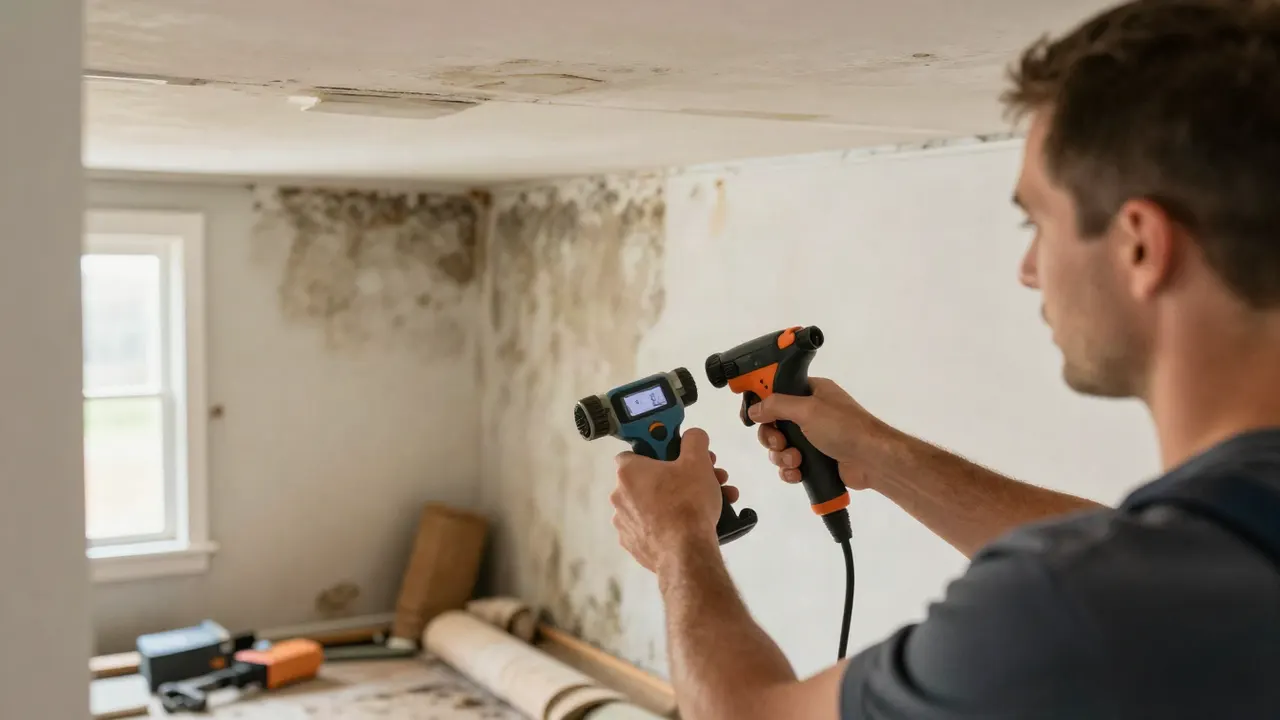
Mold after a basement leak in Falls Church usually starts growing within 24 to 48 hours of the water showing up, and you remove it by stopping the leak, drying the space below 60% relative humidity, then physically cleaning or removing every wet material it has colonized. Surface mold on concrete and tile can be scrubbed with a detergent solution; mold inside drywall, insulation, carpet padding, or ceiling tile has to be cut out and thrown away because cleaning it just spreads spores.
The rest of this guide walks through the exact steps we use on basement mold cleanup in Falls Church, what it costs in 2026, what Virginia insurance actually pays for, and the mistakes that turn a two-day job into a two-week one.
How fast does mold grow after a basement leak in Falls Church?
Mold growth after a basement leak in Falls Church begins in 24 to 48 hours when indoor humidity stays above 60% and organic materials stay wet. Concrete itself does not feed mold, but the dust, drywall paper, cardboard boxes, wood framing, and carpet padding sitting on it do - and those are wet the moment water touches them.
Falls Church basements are especially prone to this because so many homes here were built between 1930 and 1965 with block foundations, no vapor barrier, and floor drains that tie into the same storm line as the street. When we get a heavy rain - and we get them every spring and again in late summer - hydrostatic pressure pushes water through the block joints before the sump pump can keep up. That water is not clean. It carries soil, organic matter, and spores that were already dormant in the block.
Three conditions have to line up for mold to take hold:
- Moisture - any surface that stays damp for more than a day
- Food - drywall paper, wood, cardboard, fabric, dust
- Warmth - anything above roughly 40°F, which is every finished basement in Falls Church year-round
Take away any one of those and mold stops. That is why drying the space fast matters more than anything else you do.
Step-by-step: how to remove mold after a basement leak in Falls Church VA
Removing mold after a basement leak in Falls Church VA is a five-step job: fix the water source, dry the space, contain the work area, remove porous materials, and clean what is left. Skipping any step means the mold comes back within a few weeks.
Step 1: Stop the water and find the source
Mold will not stay gone while water is still coming in. Before you touch a sponge, figure out whether the leak is a failed sump pump, a cracked block joint, a burst pipe, or a backed-up floor drain. If you are standing in more than an inch of water, get it out first - our team handles Basement Water Removal Falls Church VA with truck-mounted extraction and can usually have a standard Falls Church basement dry to the touch in a day.
Step 2: Dry the space below 60% relative humidity
Open windows only if the outdoor humidity is lower than indoors - in a Virginia August, that is rarely true. Run a dehumidifier rated for the square footage, plus box fans to move air across the floor and up the walls. A $200 consumer dehumidifier pulls about 50 pints a day; a professional unit pulls 130 pints or more. That difference is why a wet basement that takes a homeowner two weeks to dry takes us two days. If you want the numbers, we measure with Moisture Mapping and Thermal Imaging Falls Church VA so we know exactly where the wet pockets are hiding behind finished walls.
Step 3: Contain the work area
Seal doorways with 6-mil plastic and tape. Shut off HVAC returns in the basement so spores do not get pulled through the house. Wear an N95 or P100 respirator, sealed goggles, and gloves. This is not optional - disturbing a mold colony sends thousands of spores into the air, and you will breathe them.
Step 4: Remove porous materials
Anything porous that got wet and stayed wet for more than 48 hours comes out. That means drywall up to at least 12 inches above the visible water line, fiberglass insulation, carpet and pad, ceiling tile, and cardboard. Bag it in 6-mil poly, seal the bags, and take them out through a window or directly outside - not through the rest of the house.
Step 5: Clean and treat hard surfaces
Concrete block, floor slab, joists, and framing can be cleaned. Scrub with a detergent solution, rinse, then apply a borate-based or quaternary ammonium mold treatment. Do not use bleach on porous surfaces - it kills surface mold but leaves the roots, and the water in bleach feeds what is left. Bleach is fine on glazed tile and glass, nothing else.
After cleaning, run the dehumidifier for at least 72 more hours and re-check moisture with a pin meter. If the reading climbs back above 15% on wood, you missed a wet pocket.
Is black mold in a Falls Church basement dangerous?
Black mold in a Falls Church basement is dangerous when it is Stachybotrys chartarum and the spores are airborne in high concentrations - it produces mycotoxins that cause coughing, headaches, sinus irritation, and asthma flare-ups. Not every black-colored mold is Stachybotrys, though. Cladosporium and Aspergillus are also dark and far more common in Falls Church basements.
You cannot tell them apart by looking. The only way to know is lab testing, which is why we run Mold Inspection and Testing Falls Church VA before we start any removal - air samples plus a surface swab, results back in 24 to 48 hours. If you or anyone in the house has asthma, is pregnant, is over 65, or is immunocompromised, do not do this work yourself. Move out of the affected area until it is clean.
What does mold removal cost in Falls Church in 2026?
Mold removal in Falls Church in 2026 runs $1,200 to $6,500 for most residential basements, with the average job landing around $2,800. The price depends almost entirely on how much porous material has to come out and how big the affected area is.
Typical 2026 pricing in this area:
- Mold inspection and lab testing: $250 to $600
- Small area (under 30 sq ft, surface mold on concrete): $500 to $1,200
- Mid-size job (30 to 100 sq ft, some drywall removal): $1,500 to $3,500
- Large or whole-basement job (100+ sq ft, framing and insulation affected): $4,000 to $10,000+
- Post-remediation clearance testing: $200 to $450
Add $400 to $900 if the basement was finished and drywall has to be replaced, painted, and trimmed back out. Add $300 to $700 if the HVAC system pulled spores through the house and the ducts need cleaning. If the leak was a sewage backup rather than clean groundwater, the price climbs because everything the water touched is Category 3 contaminated and has to be removed, not cleaned - that is a different job, and we handle it as Sewage Backup Cleanup Falls Church VA.
Does insurance cover mold removal after a basement leak?
Homeowners insurance in Falls Church covers mold removal when the mold is the direct result of a covered sudden event - a burst pipe, a failed water heater, a washing machine hose that let go. It does not cover mold from long-term seepage, poor maintenance, or a sump pump that has been failing for months.
Virginia policies typically cap mold remediation at $10,000 per occurrence unless you bought a rider. Flood damage from rising groundwater is excluded from standard homeowners policies entirely - that is NFIP or a private flood policy, and those have their own mold sublimits.
What we tell every Falls Church homeowner: document everything before you throw it away. Photograph the water line on the drywall, the wet boxes, the mold itself. Keep the receipts for the dehumidifier rental and any hotel nights. We provide a written scope with moisture readings and photos that adjusters accept, and we bill the carrier directly on most claims.
Common mistakes we see on Falls Church mold jobs
The mistakes that turn a small Falls Church mold job into a big one are almost always the same five, and we see them on roughly half the calls we run.
- Bleaching the wall and calling it done. Bleach kills what is on the surface. The roots stay in the block, and three weeks later you have mold again.
- Drying with a fan and an open window in July. Virginia summer air is 70%+ humidity. You are adding moisture, not removing it.
- Painting over it. Kilz and mold-resistant paint are for prevention after cleaning, not for covering an active colony. The mold eats through the paint.
- Pulling out the drywall without containment. One swing of a hammer sends spores through the whole house. Now the upstairs closets smell musty too.
- Skipping the clearance test. You cannot see mold spores. The only proof the job is done is a post-remediation air sample that comes back at or below outdoor levels.
We also see homeowners skip the dehumidification step because the surface feels dry. It is not. Concrete block wicks water 8 to 12 inches up from the floor and holds it for weeks. If you do not dry the block, you have not fixed anything.
How to prevent mold after a basement leak in Falls Church VA
Preventing mold after a basement leak in Falls Church VA comes down to three things: keep water out, keep the space dry, and catch leaks in the first 24 hours. Everything else is detail.
What actually works in this area:
- Test your sump pump every March and again in September. Pour a bucket of water in the pit and watch it cycle. If it hesitates, replace it before the spring rains.
- Keep indoor humidity between 30% and 50%. A $30 hygrometer from any hardware store tells you where you stand. Run a dehumidifier from April through October.
- Clear gutters and extend downspouts 6 to 10 feet from the foundation. Most Falls Church block-foundation seepage we see starts with a downspout dumping water right at the wall.
- Seal block joints and floor cracks with hydraulic cement or epoxy injection. This is a $400 to $1,200 job and it stops the majority of minor seepage.
- Check washing machine hoses and water heater fittings every six months. Burst supply lines are the number one cause of sudden basement flooding we respond to.
- Keep cardboard and fabric off the floor. Store in plastic bins on shelving at least 4 inches up.
If your basement has flooded more than twice in five years, the real fix is waterproofing - interior drain tile, a vapor barrier, and a properly sized sump system. That is a $4,000 to $9,000 project, but it is cheaper than remediating mold every other spring.
When to call a professional
Call a professional when the mold covers more than 10 square feet, when it is inside wall cavities or under flooring, when the leak was sewage or floodwater, or when anyone in the house has respiratory issues. Those are the cases where DIY cleaning does more harm than good.
We are a licensed and insured mold remediation and water damage crew based in Falls Church. We handle Mold Remediation Falls Church VA from inspection through clearance testing, and we do the water damage repair that has to happen before the mold work starts. If you are not sure whether you have a mold problem or just a musty smell, we will tell you straight - sometimes the answer is a $40 dehumidifier, and we say so.
Homeowners across Water Damage in Downtown Falls Church and the surrounding neighborhoods call us because we show up, we test before we treat, and we do not sell remediation you do not need.
Frequently Asked Questions
How do I remove mold after a basement leak in Falls Church?
Stop the leak, dry the space below 60% humidity, contain the area with plastic, remove all wet porous materials like drywall and carpet, then scrub hard surfaces with detergent and apply a mold treatment. Most Falls Church basements take 3 to 5 days start to finish. Anything over 10 square feet should go to a pro.
Is black mold dangerous in Falls Church VA?
It can be. Stachybotrys produces mycotoxins that trigger coughing, headaches, and asthma attacks. Not all black mold is toxic, and you cannot tell by looking - lab testing runs $250 to $600 and gives you a real answer in 24 to 48 hours.
How much does mold removal cost in Falls Church?
In 2026, most Falls Church basement mold jobs run $1,200 to $6,500, averaging around $2,800. Small surface-only jobs start near $500. Whole-basement remediation with drywall replacement can hit $10,000. Testing and clearance add $450 to $1,050.
Does insurance cover mold removal in Falls Church?
Yes, if the mold came from a covered sudden event like a burst pipe or failed water heater. Standard Virginia policies cap mold at $10,000 per occurrence. Long-term seepage and groundwater flooding are excluded - flood needs a separate NFIP or private policy.
Who does mold remediation near me in Falls Church?
Water Damage Falls Church VA handles mold inspection, testing, remediation, and clearance for homes across Falls Church, Seven Corners, West Falls Church, and Broadmont. We are licensed and insured, we test before we treat, and we bill most carriers directly.
Get help with Water Damage in Falls Church
If your basement leaked and you are already seeing dark spots on the block or smelling that musty odor, the clock is running. We inspect, test, and remediate - and we fix the water problem that caused it so it does not happen again.
Call Water Damage Falls Church VA at 571-760-4393 for same-day inspection and a written scope you can hand to your insurance adjuster.