Why is my basement flooding after heavy rain in Falls Church
Heavy rain basement flooding in Falls Church almost always comes down to water pressure, drainage, or a failed sump pump. Here's how to find your cause and fix it.
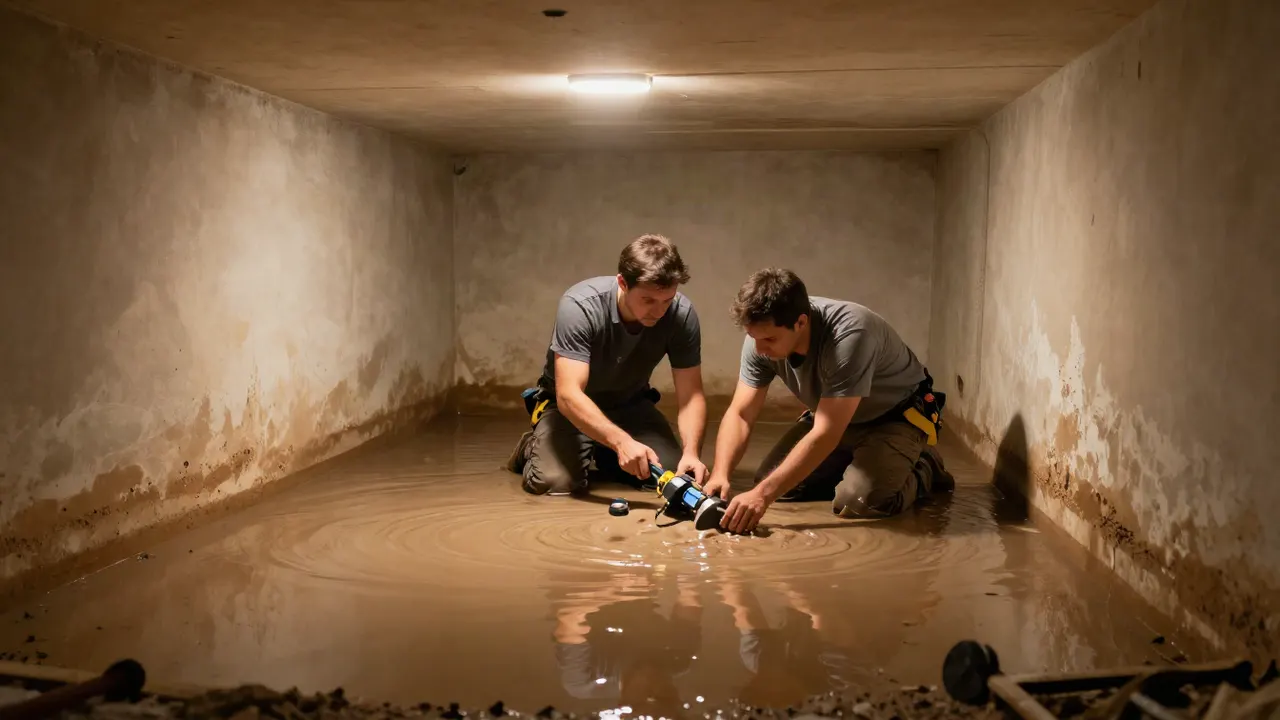
Your basement floods after heavy rain because water is finding a path in faster than your drainage system can move it out. In Falls Church, that almost always means one of three things: hydrostatic pressure pushing groundwater through the foundation, a sump pump that quit or couldn't keep up, or surface water running toward the house instead of away from it. The rest of this post walks through the specific causes we see across Falls Church, how to tell which one is yours, and what actually stops it.
The short answer: why heavy rain floods Falls Church basements
Basement flooding after heavy rain in Falls Church VA is the result of groundwater and surface water overwhelming a home's drainage capacity. When the soil around your foundation saturates, water has nowhere to go but through the path of least resistance - cracks, joints, floor drains, or a failed sump pit.
Falls Church sits on a mix of clay-heavy soils and older housing stock. Clay doesn't absorb water quickly. During a two-inch rain event, the ground around your foundation can go from dry to saturated in under an hour. Once that happens, the water table rises and pushes against your foundation walls. That pressure - hydrostatic pressure - is the single most common driver of basement water problems Falls Church homeowners deal with.
If you've already got standing water, the priority is getting it out before it spreads into drywall, insulation, and flooring. Our team handles Basement Water Removal Falls Church VA with truck-mounted extraction and commercial drying equipment, and we can usually be on-site the same day you call.
The five causes we find most often in Falls Church
After enough basement flood calls in Falls Church, patterns emerge. These are the five causes we diagnose most frequently, roughly in order of how often they show up.
1. Sump pump failure or undersizing
A sump pump that's five or more years old, or one that was sized for a smaller volume of water, is the number one culprit we find. Pumps fail for predictable reasons: a stuck float switch, a burned-out motor, a clogged intake screen, or a power outage during the storm. If your pump runs but the pit still fills, it's undersized or the discharge line is partially blocked.
We see this constantly in older Falls Church neighborhoods where the original pump was installed decades ago and never upgraded. A modern 1/3 HP pump moves roughly 40-50 gallons per minute at a 10-foot lift. If your pit is filling faster than that, you need a larger pump or a battery backup system.
2. Hydrostatic pressure through foundation walls and floors
This is the one homeowners can't see coming. Water saturates the soil outside, builds pressure against the foundation, and forces its way through hairline cracks, cold joints, or the cove joint where the wall meets the floor. You'll often see a thin line of water along the base of the wall or a damp patch spreading across the floor.
Hydrostatic pressure doesn't require a visible crack. Concrete is porous. Under enough pressure, water migrates through the material itself. This is why some Falls Church basements flood even when the walls look intact.
3. Failed or clogged drain tile
Drain tile - the perforated pipe that runs around the footing of your foundation - collects groundwater and routes it to the sump pit. When it clogs with sediment or roots, or when it collapses after decades underground, water has nowhere to go. It backs up against the foundation and finds its way inside.
Homes built before 1980 in Falls Church often have clay or cast-iron drain tile that's reached the end of its service life. Replacement is a major job, but it's sometimes the only permanent fix.
4. Grading and gutter problems
If the ground around your foundation slopes toward the house instead of away from it, every rain event sends surface water directly to your basement walls. Add clogged gutters and downspouts that discharge within three feet of the foundation, and you've created a funnel.
The fix here is often simple: extend downspouts 6-10 feet from the foundation, regrade the soil so it drops at least six inches over the first ten feet, and clean gutters twice a year. We see this solve recurring basement water problems Falls Church homeowners assumed were structural.
5. Sewer backup during heavy rain
When the municipal storm sewer surcharges during a heavy rain, water can back up through your floor drain or a low-level fixture. This is different from groundwater flooding - the water is often grey or dark and carries debris. It's also a health hazard that requires proper disinfection, not just drying.
If your basement floods through the floor drain during storms, you likely need a backwater valve. Our team handles Sewage Backup Cleanup Falls Church VA with full containment and antimicrobial treatment.
Why Falls Church specifically floods so easily
Falls Church has a combination of factors that make basements more flood-prone than the average Northern Virginia community. The city sits at the headwaters of Four Mile Run and Cameron Run, both of which back up during sustained rain. The soil is heavy in clay and silt, which drains slowly. And a large share of the housing stock was built between 1940 and 1975, before modern waterproofing standards.
Neighborhoods like Seven Corners Water Damage see repeated issues because of the low-lying topography and the concentration of mid-century homes with original drain systems. The same pattern shows up in Broadmont and along the older streets near downtown.
Storm intensity has also shifted. The 100-year storm in this region now drops more rain than it did 30 years ago. Systems designed for the old rainfall averages simply can't keep up with the new ones.
How to stop basement flooding from rain in Falls Church
Basement flooding prevention tips Falls Church VA homeowners can act on fall into three tiers: cheap fixes, mid-range upgrades, and structural work. Start at the top and work down.
Low-cost fixes (under $500)
- Extend downspouts 6-10 feet from the foundation.
- Clean gutters and downspouts twice a year - spring and late fall.
- Regrade soil so it slopes away from the house at least six inches over ten feet.
- Test your sump pump monthly by pouring a bucket of water into the pit.
- Install a water alarm near the sump pit and floor drain.
Mid-range upgrades ($500-$3,500)
- Replace an aging sump pump with a properly sized unit plus a battery backup.
- Install a backwater valve on the main sewer line to stop storm surcharge.
- Add a secondary sump pit and pump for redundancy.
- Seal visible foundation cracks with hydraulic cement or polyurethane injection.
Structural work ($3,500-$15,000+)
- Interior drain tile system with a new sump pit.
- Exterior waterproofing membrane and footing drain replacement.
- Full crawl space encapsulation to control groundwater vapor.
Typical 2026 pricing in this area runs $150-$400 for crack injection, $800-$2,000 for a sump pump replacement with backup, and $5,000-$12,000 for a full interior drain tile system. Exterior work costs more because of excavation.
If your crawl space is the entry point rather than the basement floor, Crawl Space Water Removal Falls Church VA plus encapsulation is usually the right combination.
What to do when your basement floods after a storm
What to do when basement floods after storm Falls Church: stop the water source if you can, kill the power to the affected area, and start extraction within the first few hours. Mold can begin colonizing wet organic materials in 24-48 hours.
- Safety first. Don't wade into standing water if the power is still on. Shut off breakers to the basement from a dry location.
- Document everything. Photos and video of the water line, damaged items, and the source. Your insurance adjuster will want these.
- Stop the source if possible. If it's a failed sump pump, you may be able to swap in a backup. If it's a sewer backup, don't touch the water - call a pro.
- Start extraction. Wet/dry vacs help for small amounts. Anything over an inch of standing water needs truck-mounted extraction.
- Get air moving. Box fans and a dehumidifier slow mold growth, but they don't replace professional drying.
- Call your insurance company. Most policies require you to mitigate damage promptly or they can reduce the claim.
For anything beyond a small puddle, Emergency Water Extraction Falls Church VA is the fastest path to stopping secondary damage. We extract, set drying equipment, and monitor moisture until the structure is back to dry standard.
Common mistakes homeowners make after a basement flood
The mistakes that turn a manageable flood into a $20,000 mold job are almost always the same ones. Watch for these.
- Assuming it will dry on its own. Concrete and framing hold moisture for weeks. Surface-dry is not dry.
- Running a shop vac and calling it done. Extraction removes standing water, not the moisture trapped in drywall, insulation, and subfloor.
- Skipping the dehumidifier. Without controlled drying, humidity stays above 60% and mold takes hold.
- Throwing away damaged items too fast. Many contents can be restored through Content Cleaning and Pack-Out Falls Church VA rather than replaced.
- Not checking for hidden moisture. Water wicks up drywall and into wall cavities where you can't see it. Thermal imaging finds it.
- Ignoring the smell. A musty odor two weeks after a flood means mold is already growing.
If you smell that musty odor, don't wait. Mold Inspection and Testing Falls Church VA will tell you whether you have an active problem and how far it's spread.
When to call a professional
Call a professional when the water is more than a puddle, when it came in through a sewer or floor drain, when it's been sitting more than a few hours, or when you can't find the source. Those four conditions cover the vast majority of calls we run.
We handle the full scope: extraction, structural drying, moisture mapping, mold remediation if needed, and reconstruction. You get one crew, one point of contact, and one invoice. If you're dealing with recurring basement water problems Falls Church, we'll also tell you what's causing it so you can fix the source rather than clean up after it every storm.
Water Damage Falls Church VA is a locally operated Falls Church water damage restoration company. We work in the same neighborhoods we live in, and we know how these older homes behave in a heavy rain.
Frequently Asked Questions
Why is my basement flooding after heavy rain in Falls Church?
Groundwater saturates the clay soil around your foundation and pushes through cracks, joints, or a failed sump pit. Surface water from bad grading or clogged gutters adds to it. Most Falls Church basements flood from a combination of hydrostatic pressure and a sump pump that couldn't keep up.
How do I stop my basement from flooding in Falls Church VA?
Start with grading, gutter extensions, and a working sump pump with battery backup. Those three fixes stop most rain-driven flooding. If water still comes in, you likely need crack injection, a backwater valve, or interior drain tile. A moisture inspection tells you which.
Does insurance cover basement flooding from rain in Falls Church?
Standard homeowners policies usually cover sudden water damage from a failed sump pump or burst pipe, but not groundwater seepage or surface flooding. Those require a separate flood policy through NFIP or a private carrier. Read your policy or call your agent before assuming coverage.
Who do I call for basement flooding in Falls Church?
Call a licensed water damage restoration company that handles extraction, drying, and mold prevention in one scope. Water Damage Falls Church VA responds same-day for standing water and can be reached at 571-760-4393. Don't call a general handyman for anything beyond a small puddle.
How much does basement flood cleanup cost in Falls Church?
Typical 2026 pricing runs $1,200-$3,500 for a small basement with an inch or two of water, and $4,000-$12,000 for a fully finished basement with contaminated water. Cost depends on square footage, water category, and how much material has to be removed and replaced.
Get help with Water Damage in Falls Church
Standing water in your basement gets worse every hour it sits. We extract, dry, and document the damage so your insurance claim goes smoothly and your basement comes back dry.
Call Water Damage Falls Church VA at 571-760-4393 for same-day emergency response across Falls Church and the surrounding neighborhoods.