Which Falls Church neighborhoods flood most and why
The neighborhoods that flood most in Falls Church are Seven Corners, West Falls Church, Broadmont, and the low blocks near Four Mile Run. Here is why, block by block.
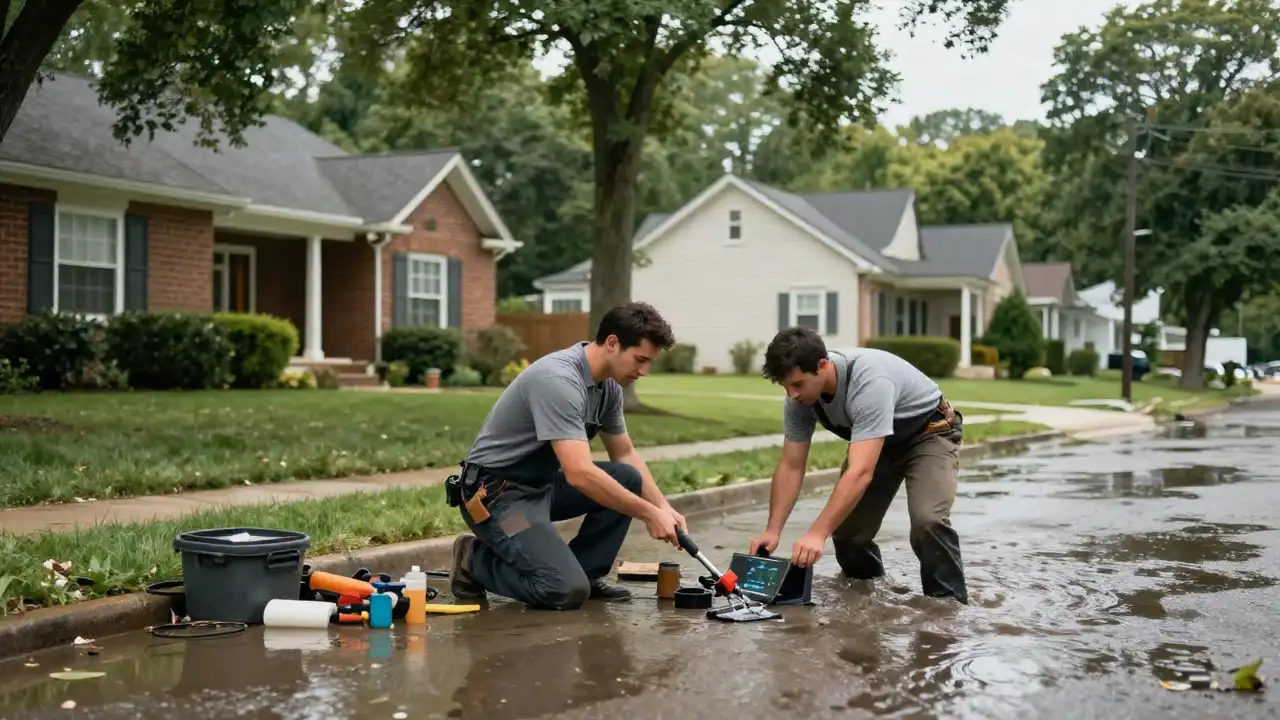
The Falls Church neighborhoods that flood most are Seven Corners, West Falls Church, Broadmont, and the low-lying blocks along Four Mile Run and Tripps Run - and they flood because those areas sit at the bottom of a 1950s storm sewer system that was never sized for the kind of 3-inch-per-hour downpours we now get two or three times a year. The rest of the city floods too, but it is usually a basement seep or a backed-up floor drain rather than a street under water.
We have pumped out crawl spaces in Broadmont after a July thunderstorm and shop-vacced finished basements in Seven Corners in February. The pattern is consistent enough that we can usually guess the neighborhood from the call. Below is what we see, block by block, and what you can do about it.
Which Falls Church neighborhoods flood most
Seven Corners, West Falls Church, Broadmont, and the Four Mile Run corridor are the four areas we get called to most often for storm flooding in Falls Church. That ranking comes from our own dispatch records and from the city's repeated flood studies, not from a national risk map that treats the whole 22041 and 22042 ZIP codes as one blob.
Here is the short version, ranked by how often we are called out:
- Seven Corners - the lowest ground in the city, where Route 7, Route 50, and Wilson Boulevard all meet. Every storm that stalls over the area sends water downhill into the same parking lots and garden-apartment basements.
- West Falls Church - the Tripps Run watershed. The creek tops its banks near Shreve Road and the W&OD Trail crossing during heavy summer storms.
- Broadmont - older homes on crawl spaces and finished basements, with mature trees whose roots have cracked more than a few clay sewer laterals.
- Downtown Falls Church and the City Center - not a creek problem, a storm-drain problem. The drains on Broad Street and Washington Street fill with leaves in October and stay clogged until December.
If you live in one of those four areas, you already know the sound of water coming in. If you are in Virginia Forest or Hillwood up on the higher ground, your risk is mostly sewer backup and sump failure, not surface flooding.
Why do Falls Church neighborhoods flood
Falls Church neighborhoods flood because the city sits on a ridge that drains in three directions, and the storm sewer that handles that drainage was built for a smaller, less paved version of the city. Add clay soil, aging laterals, and more impervious surface every year, and you get a system that hits its limit at about 2 inches of rain in an hour.
Four things drive almost every flood call we run:
- Clay soil. Falls Church sits on heavy Virginia clay that absorbs water slowly. After 20 minutes of hard rain, the ground is saturated and every additional drop runs off.
- Combined and undersized storm sewers. In the older parts of the city, stormwater and sanitary lines share trenches, and the storm lines were sized for a 1950s rainfall curve. A 2026 downpour overwhelms them.
- Tree roots in sewer laterals. The willow oaks and maples that make Broadmont and Downtown look the way they do also send roots into clay tile laterals. When the line is already half-blocked, the next storm pushes sewage backward into the lowest fixture in your house.
- Grading and downspouts. A lot of the homes we see were regraded when a patio or driveway went in, and the downspouts now discharge two feet from the foundation instead of into a dry well.
That combination is why a storm that drops an inch in Arlington can put six inches of water in a Seven Corners basement. The rain is the same. The drainage is not.
Falls Church flood zones and the creeks that drive them
Falls Church flood zones follow two creeks - Four Mile Run on the south and Tripps Run on the west - plus the low pocket at Seven Corners where the two watersheds nearly meet. FEMA maps the Four Mile Run corridor as a Special Flood Hazard Area, and the city has its own floodplain overlay that adds a foot of freeboard on top of the federal base elevation.
What that means in practice: if you are in the AE zone along Four Mile Run, your lender will require flood insurance, and your finished basement is the first thing to go when the creek rises. If you are in the shaded X zone a block uphill, you are not required to carry it, but we still get calls from those addresses every summer.
Tripps Run is the quieter of the two, but it is the one that catches people off guard. It runs through West Falls Church, and during the July and August storms it can rise four feet in under an hour. Homeowners on Shreve Road and the streets feeding off it have told us the same story for years: the creek looks fine, then it is in the yard.
Neighborhood-by-neighborhood flooding history
Falls Church neighborhood flooding history repeats itself in the same blocks, which is the single most useful thing to know if you are buying or insuring a home here. Ask a neighbor on the low side of the street how many times they have replaced a water heater, and you will get a better answer than any map.
Seven Corners
Seven Corners is the lowest point in the city and the first place we send a truck when a storm stalls. The garden apartments and the commercial lots along Route 7 take on water from three directions at once, and the parking-lot drains back up before the rain stops. If you live here, keep a wet/dry vacuum and a sump pump on the shelf. You will use them.
West Falls Church
West Falls Church floods from Tripps Run, and the water usually arrives through a basement floor drain rather than a window well. That is a sewer surcharge, not a creek overflow - the municipal line is full, and the water has nowhere to go but up through your lowest drain. A backwater valve on the lateral is the single best $800 to $1,500 you can spend here.
Broadmont
Broadmont has the oldest housing stock in the city and the most mature tree canopy. The flooding we see is split between crawl-space seepage after a multi-day rain and sewer backups from root intrusion. If your home was built before 1960, the lateral is probably clay tile, and it is probably cracked.
Downtown Falls Church and City Center
Downtown Falls Church and the City Center flood from clogged storm drains, not creeks. The drains on Broad and Washington fill with leaves in October, and the first big storm of the season puts water into the sidewalk-level storefronts and basement mechanical rooms. If you own a commercial space here, get the drains cleared before Thanksgiving.
Virginia Forest and Hillwood
Virginia Forest and Hillwood sit high enough that surface flooding is rare. Their risk is sump pump failure and appliance leaks, and we see a spike in both during the first hard freeze of January. A failed sump pump in a finished basement here can do $15,000 to $40,000 in damage before anyone notices.
Wherever you are in the city, when water does get in, the first call is usually for Emergency Water Extraction Falls Church VA - we pull the standing water out, then figure out where it came from.
What to watch out for after a flood
The mistakes we see after a Falls Church flood are almost always about speed and sequencing. Water does its real damage in the first 24 to 48 hours, and the wrong first move can turn a $3,000 cleanup into a $30,000 rebuild.
Watch for these:
- Waiting for the water to go down on its own. It will not, and every hour it sits, it wicks higher into drywall and framing. Mold can start colonizing wet drywall in 24 to 48 hours.
- Running a shop vac and calling it done. A wet/dry vac pulls up surface water. It does nothing about the moisture inside the wall cavity or under the floor.
- Turning the heat up to dry the house. High heat without air movement and dehumidification just moves moisture into the cooler parts of the structure.
- Skipping the sewage question. If the water came up through a floor drain during a storm, it is category 3 - contaminated. That is a different cleanup than a clean supply-line leak, and it needs different protective gear and disposal.
- Not documenting before you clean. Photograph everything before you move it. Your insurance adjuster will want it, and so will ours.
If the water came up through a drain, do not treat it like a clean-water spill. Call for Sewage Backup Cleanup Falls Church VA and let us handle the contaminated material properly.
How to protect your home from flooding in Falls Church
You can cut your flood risk in Falls Church with five changes, and four of them cost less than a single insurance deductible. None of them are exotic. They are the same fixes we recommend to every homeowner in the low blocks.
- Install a backwater valve on the sewer lateral. $800 to $1,500 installed. It stops municipal sewage from backing into your basement during a storm surcharge.
- Extend your downspouts 6 to 10 feet from the foundation. $50 to $200 in parts. This alone solves a surprising number of basement seepage calls.
- Keep the storm drains on your street clear. Ten minutes with a rake in late October saves you a flooded basement in November.
- Test your sump pump before every storm season. Pour a bucket of water into the pit and watch it cycle. If it hesitates, replace it - a new pump is $150 to $400, and a flooded basement is not.
- Have your sewer lateral camera-inspected every 5 years if your home was built before 1970. $250 to $500. It catches root intrusion before it becomes a backup.
If you do get water in, the drying is as important as the pumping. We use Dehumidification and Drying Falls Church VA equipment to pull moisture out of the structure, not just the air, because a floor that feels dry can still be wet two inches down.
One more thing worth doing: if you are in Broadmont or Downtown, look at your crawl space. A wet crawl space under an older home is the source of half the musty smells we get called about, and it is usually a drainage fix, not a cleaning fix.
When to call a professional
Call a professional when the water is more than a towel-deep, when it came up through a drain, or when it has been sitting for more than a few hours. Those three conditions cover about 90 percent of the calls we run in Falls Church, and they are the ones where DIY cleanup usually makes things worse.
Specifically, call us if:
- The water is category 3 (sewage, storm surcharge, or any water that has touched the ground outside).
- You can smell a musty odor more than 48 hours after the water is gone.
- The drywall, insulation, or hardwood has been wet for more than a day.
- Your sump pump ran continuously and still could not keep up.
- You see any discoloration on the ceiling below a bathroom or the wall behind a refrigerator.
Our team handles the whole sequence - extraction, drying, and the rebuild - so you are not coordinating three contractors. We find the source, fix what caused it, and dry the structure before we close the job. If you want to see how we handle the full scope, start with Water Damage Restoration Falls Church VA.
Frequently Asked Questions
Which Falls Church neighborhoods flood most?
Seven Corners, West Falls Church, Broadmont, and the Four Mile Run corridor flood most often. Seven Corners is the lowest ground in the city, West Falls Church sits in the Tripps Run watershed, and Broadmont combines older housing with mature tree roots in clay sewer laterals.
Why does my neighborhood in Falls Church flood?
Most Falls Church flooding comes from one of four causes: clay soil that stops absorbing after 20 minutes of hard rain, storm sewers sized for 1950s rainfall, tree roots blocking clay sewer laterals, and grading that sends downspout water toward the foundation instead of away from it.
How can I protect my home from flooding in Falls Church VA?
Install a backwater valve on the sewer lateral ($800 to $1,500), extend downspouts 6 to 10 feet from the foundation, clear street storm drains each October, test your sump pump before storm season, and camera-inspect pre-1970 sewer laterals every 5 years.
Is flooding common in Falls Church Virginia?
Yes. Falls Church gets two or three storms a year that drop more than 2 inches in an hour, and those are the ones that overwhelm the storm sewer. Surface flooding is concentrated in the low blocks, but basement seepage and sewer backups happen citywide.
Who do I call for flood cleanup in Falls Church?
Call Water Damage Falls Church VA at 571-760-4393. We handle extraction, structural drying, sewage cleanup, and the rebuild, and we work directly with your insurance adjuster so you are not managing three separate contractors.
Get help with Water Damage in Falls Church
If water is in your basement right now, we can be on-site in Falls Church the same day. We pull the water, dry the structure, and fix what caused it - one crew, one invoice, no runaround.
Call Water Damage Falls Church VA at 571-760-4393 and we will get a truck headed your way.